
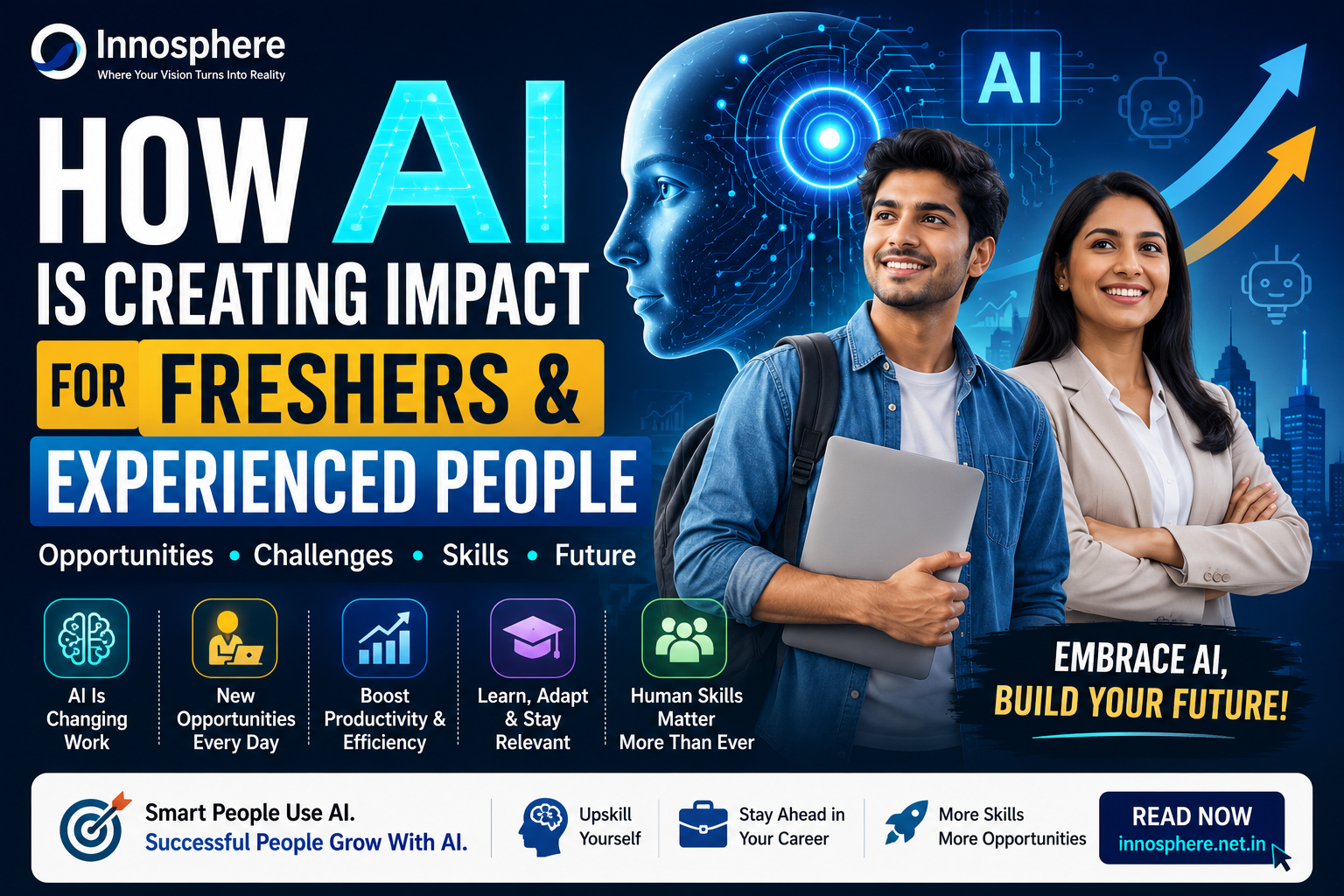
How AI Is Impacting Freshers & Experienced Professionals (2026 Guide)
Artificial Intelligence (AI) is transforming industries across the world. From healthcare and finance to education, manufacturing, and customer service, AI is changing how businesses operate and how people work.
Many people worry that AI will replace jobs completely. While AI is automating repetitive tasks, it is also creating new opportunities and changing the skills employers look for. Instead of replacing everyone, AI is becoming a tool that helps professionals work smarter and more efficiently.
In this guide, we'll explore how AI affects freshers and experienced professionals, the opportunities it creates, the challenges it brings, and how you can stay relevant in an AI-driven workplace.
What Is Artificial Intelligence?
Artificial Intelligence (AI) refers to computer systems that can perform tasks that typically require human intelligence, such as understanding language, recognizing images, analyzing data, solving problems, and making recommendations.
Popular AI tools include:
- ChatGPT
- Google Gemini
- Microsoft Copilot
- Claude AI
- GitHub Copilot
- Canva AI
How AI Is Changing the Workplace
AI is helping businesses automate repetitive work, analyze large amounts of data, improve customer support, and increase productivity. Employees are spending less time on routine tasks and more time on strategic and creative work.
Examples include:
- Automated customer support chatbots.
- Resume screening by Applicant Tracking Systems (ATS).
- AI-powered coding assistants.
- Content writing support.
- Business analytics and forecasting.
- Automated report generation.
How AI Impacts Freshers
Benefits
- Faster learning through AI tutors and assistants.
- Better resume creation using AI tools.
- Interview preparation with AI mock interviews.
- Easy access to learning resources.
- Improved productivity for assignments and projects.
- Career guidance based on skills and interests.
Challenges
- Higher competition as more candidates use AI tools.
- Employers expect stronger problem-solving skills.
- Overdependence on AI can reduce practical learning.
- Need to verify AI-generated information.
How AI Impacts Experienced Professionals
Benefits
- Automates repetitive tasks.
- Improves decision-making through data analysis.
- Saves time by generating reports and presentations.
- Enhances customer service.
- Supports faster software development.
- Increases workplace productivity.
Challenges
- Need to continuously upgrade skills.
- Changing job responsibilities.
- Learning new AI-powered tools.
- Greater focus on strategic thinking and creativity.
Jobs Most Affected by AI
| Role | AI Impact |
|---|---|
| Data Entry | High Automation |
| Customer Support | Moderate Automation |
| Content Creation | AI Assistance |
| Software Development | AI-Assisted Coding |
| Marketing | AI Analytics & Content |
| HR Recruitment | AI Resume Screening |
| Finance | AI Reporting & Analysis |
Skills That AI Cannot Easily Replace
- Critical thinking.
- Leadership.
- Emotional intelligence.
- Creativity.
- Communication skills.
- Team collaboration.
- Decision-making.
- Problem-solving.
- Negotiation.
- Ethical judgment.
How to Stay Relevant in the AI Era
- Learn AI tools relevant to your profession.
- Strengthen communication and presentation skills.
- Continue learning through online courses.
- Build practical projects and a portfolio.
- Develop analytical thinking.
- Stay updated with industry trends.
- Use AI responsibly instead of depending on it completely.
AI Is a Tool, Not a Replacement
AI can generate ideas, summarize information, analyze data, and automate repetitive work, but it cannot fully replace human creativity, empathy, ethical judgment, and relationship-building. Professionals who combine AI with strong human skills are likely to remain valuable in the workplace.
Common Myths About AI
- Myth: AI will replace every job.
Reality: AI is more likely to change many jobs than eliminate all of them. - Myth: Freshers don't need to learn AI.
Reality: Understanding AI tools is becoming increasingly valuable for new graduates. - Myth: Experienced professionals cannot adapt to AI.
Reality: Continuous learning enables professionals at all stages of their careers to benefit from AI.
Frequently Asked Questions
Will AI replace freshers?
AI is changing entry-level work by automating some routine tasks, but it also creates demand for people who can use AI effectively, learn quickly, and solve problems.
Should experienced professionals learn AI?
Yes. Learning AI tools can improve productivity and help professionals stay competitive as workplaces evolve.
What is the best approach to AI?
Use AI as an assistant to improve your work, while continuing to develop technical expertise, communication skills, creativity, and critical thinking.
How Innosphere Helps Professionals
Innosphere provides free career tools and learning resources to help students, freshers, and professionals succeed in today's changing job market.
- Free Resume Builder
- ATS Resume Checker
- Interview Preparation Guides
- Career Development Articles
- Communication Skills Resources
- HR Document Formats
- Salary & Career Tools
Conclusion
Artificial Intelligence is reshaping the future of work, but it does not eliminate the need for skilled professionals. Those who embrace continuous learning, develop strong human skills, and use AI responsibly will be better positioned to succeed.
The future belongs to people who combine technology with creativity, critical thinking, and effective communication. Rather than fearing AI, focus on learning how to work alongside it and use it to create more value.